From middle-class it is middle-income India, marketers are chasing for volumes. The 166 million households in this category is the new focus.
The findings of the report showed consumer spending falling for the first time in over four decades in 2017-18.

The Reserve Bank's growth projection for next financial year is lower than 8-8.5 per cent projected by the finance ministry in the recent Economic Survey which was tabled in Parliament on January 31. Unveiling the bi-monthly policy, RBI governor Shaktikanta Das said, "Recovery in domestic economic activity is yet to be broad-based, as private consumption and contact-intensive services remain below pre-pandemic levels."

'Election funding needs a little more transparency.'

The substantially increased economic dualism may exert lasting negative influences which could include a reduced potential for economic growth; the persistence of a very weak employment and poverty situation; rising social and political discord; and heightened vulnerability to geopolitical challenges, cautions Shankar Acharya, former chief economic adviser to the Government of India.
.jpg)
The number of poor in the country declined to 27 crore (270 million) in 2011-12, from 40.74 crore in 2004-05, Minister of State for Planning and Parliamentary Affairs Rajeev Shukla said on Wednesday.

The external environment has worsened further. While the Finnish economy entered into a recession, Swedish economic growth also dipped. The Finnish gross domestic product (GDP) dropped 0.6 per cent in October-December, 2022. It was the second quarter of negative growth, which is a technical definition of recession.
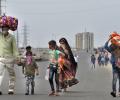
'While the poor have little say in shaping India's intellectual or public discourse, they do have a significant role in deciding political outcomes,' points out Roshan Kishore.
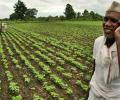
The scheme, which would give Rs 6,000 to small farmers in a year or Rs 500 a month, will add more money to the account of these cultivators than the money he/she saves every month on an average.

Majority of 'Bimaru' states register faster fall in rural poverty, while pace mostly other way round for others

The survey covered 47,535 households in rural areas and 36,065 households in urban areas.

While India's GDP growth slowed to five-year low of 5.8% in Q4, China grew at 6.4%.

The National Sample Survey Organisation has found wide disparities in the monthly consumption pattern of rural and urban households during 2007-08, with the former spending just half of what their urban counterparts did.
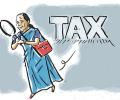
The forthcoming budget needs to delay fiscal consolidation, instead should focus more on supporting the pandemic battered-economy and boost consumption demand by offering income tax soaps and cutting fuel taxes, says a report. In a pre-budget report, India Ratings said it expects the new budget to consolidate and strengthen the plan set out in the last budget, rather than trying out new things by continue with the revenue and capital expenditure pattern of FY'22 to provide stability and consolidation to the past/ongoing efforts, and to focus on boosting demand by generating employment opportunities in areas/sectors that have been impacted more by the pandemic. The report therefore expects the finance minister to delay fiscal consolidation and make it to be a gradual and calibrated process, thus ensuring the necessary fiscal support that the economy needs is available till the recovery acquires its own momentum.
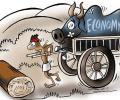
The implication of a slowdown in the financial services sector are very different (eg, likely to affect fewer people directly, and even that affecting those at the top of the income distribution) from that of a slowdown in construction, one of the most employment intensive sectors in the Indian economy (that will affect aggregate demand much more).'

The challenges before the coming Budget are more daunting than those in 2021, reveals A K Bhattacharya.

There is lack of scientific basis in computing the poverty line, says govt.
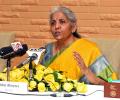
Macroeconomic management is usually a lot more comfortable with lower fiscal deficits. The sooner we get there, the better for the economy, says former Chief Economic Adviser to the Government of India Shankar Acharya.
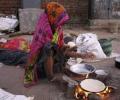
The World Bank said improved infrastructure, specifically rural electrification, has had far-ranging effects

The Raghuram Rajan committee report for evolving a composite development index of states, submitted to the finance ministry today, has a note of dissent from member Shaibal Gupta.

The GDP always has a base year, which defines the composition of the economy in that year. As the composition changes, the base year needs to be revised regularly. Abhishek Waghmare explains how that is done.

The Reserve Bank on Friday retained the GDP forecast for the current financial year at 9.5 per cent and flagged global semiconductor shortages, elevated commodity prices and potential global financial market volatility as downside risks to economic growth. In his address after the three-day meeting of the rate-setting panel, RBI Governor Shaktikanta Das said recovery in aggregate demand gathered pace in August-September, and it is reflected in high-frequency indicators, like railway freight traffic; port cargo; cement production; electricity demand; e-way bills; GST and toll collections. "The ebbing of infections, together with improving consumer confidence, has been supporting private consumption," he said, and added the pent-up demand and the festival season should give further fillip to urban demand in the second half of the financial year.

The Seventh Pay Commission had decided to choose the CPI-IW as the index for adjusting inflation for central government employees.
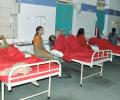
Taking away free healthcare facilities, as recommended by the Aayog, would place a huge burden on the people, especially in rural areas, says Devanik Saha.
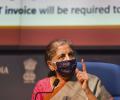
'Without reviving employment, consumer confidence will not go up.'

Only three percent of Indians pay income tax; our tax-GDP ratio is among the lowest in the world. This must change. Our elites must realise that India's poverty has damaging consequences for them, and that they can help decrease it. The food security bill, with all its limitations, will hopefully contribute to generating such awareness, says Praful Bidwai.
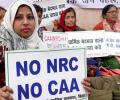
Opponents of the CAA and NRC have gone to town accusing the BJP of an ulterior motive (read, disenfranchisement of Muslims) in implementing the NRC. By the same token it can be alleged that anti-CAA opponents have a nefarious agenda in mind that would be scuttled by the implementation of the NRC: Namely the accrual of dedicated vote banks and the restoration of Muslim hegemony over at least parts of India, especially Bengal and Assam, argues Vivek Gumaste.

Several states that imposed prohibition in the past lifted it once revenue loss began to pinch

Is the worst over for Indian banks? The past two years saw them ride on treasury trades as deposits soared and credit growth dipped sharply. Gross and net non-performing assets (NPAs) moved south, and the provision coverage ratio (PCR), capital buffers, and profitability indicators are back at pre-pandemic levels. So, what's the plot ahead?

Universal basic income or social security? Economist Nitin Desai feels we need a blueprint for universal health care and pensions to help the vulnerable section.

Chief Economic Advisor Arvind Subramanian's interview.
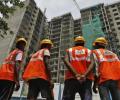
Modi govt must bring about reforms to kick-start big-ticket infra projects.
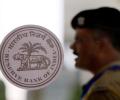
The windfall from RBI may be used to trim borrowing, help fund Rs 3.3 lakh crore capex plan, capitalise banks and provide fiscal stimulus to some stressed sectors, experts and economists said.

Union Minister Prakash Javadekar on Tuesday dismissed Bharatiya Janata Party member of Parliament Dilip Gandhi's remarks that all studies linking cancer to tobacco have come from abroad and that there is no Indian survey report to confirm it.
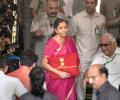
'The household sector, which is still the largest contributor of financial savings, has been experiencing a decline in the last six years, and it has fallen below 8% of GDP.'
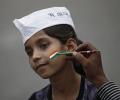
India Inc is encouraged by a determined Budget.
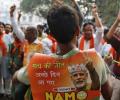
'Success will require political skill, not just economic expertise'

'Biometric Aadhaar-based surveillance is not only about violation of privacy, but also about the treasure hunt for unprecedented financial surveillance and economic intelligence in the economic history of mankind,' asks Gopal Krishna.
 © 2026 Rediff.com - Advertise with us - Disclaimer - Privacy Policy - Sitemap - Feedback - About us - Terms of use - Grievances